

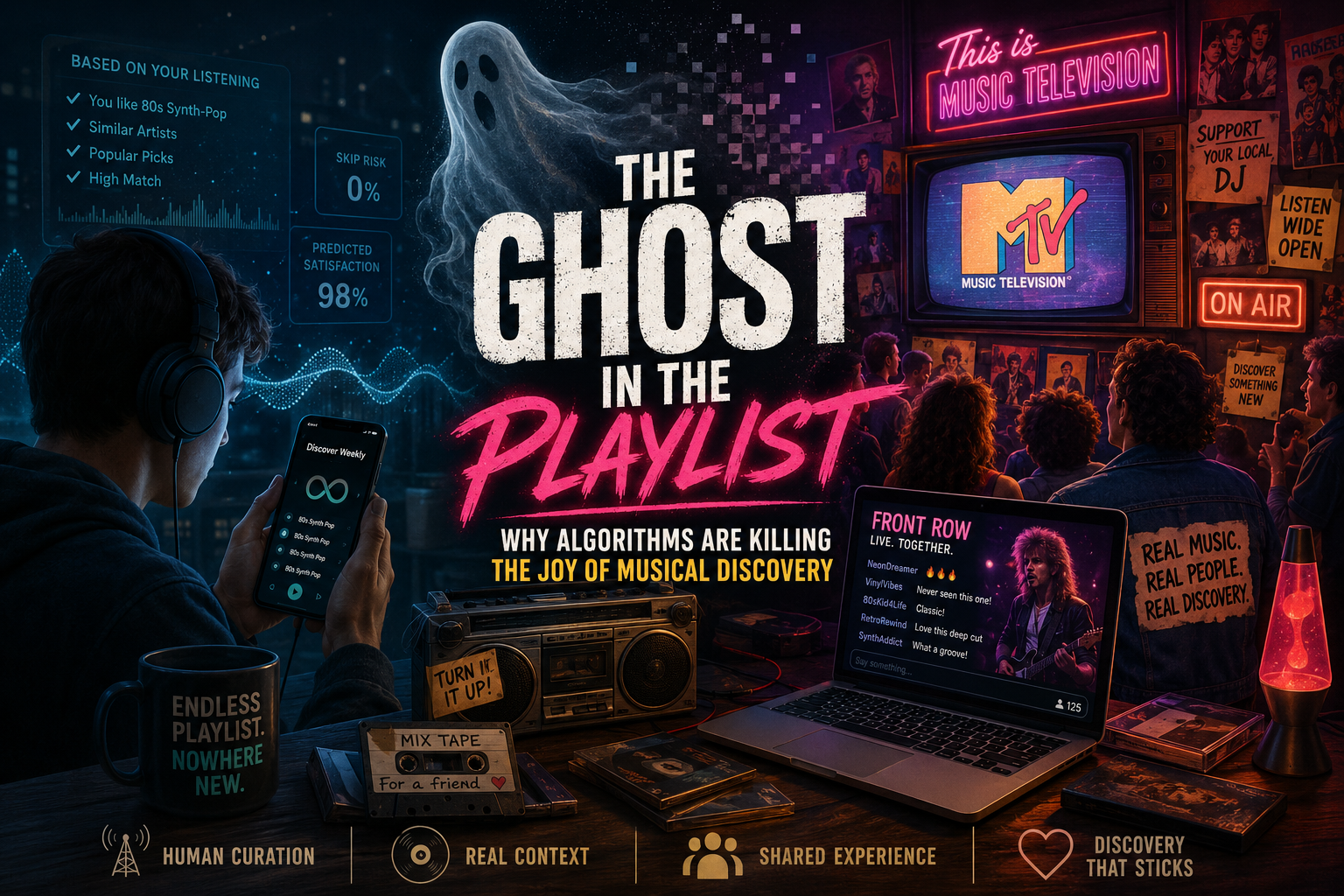
The Ghost in the Playlist: Why Algorithms are Killing the Joy of Musical Discovery
There is a distinct modern frustration familiar to anyone who loves music: you sit down, open your favorite streaming app, and let it pick the tracks. Hours pass, the music is perfectly pleasant, yet you feel entirely uninspired.
You aren't imagining things. Modern music streaming platforms, driven by hyper-optimized recommendation algorithms, have fundamentally changed how we interact with sound. But in optimizing for seamless, frictionless listening, they have quietly broken the most magical part of audio culture: true musical discovery.
To understand what we’ve lost, we have to look back at the era before the data stream—the golden days of broadcast radio and MTV—and look forward to how a new wave of platforms is fighting to bring that magic back.
The Echo Chamber of "People Also Like"
On paper, algorithmic curation sounds like a miracle. Platforms track your skips, your replays, the time of day you listen, and the acoustic profiles of your favorite tracks. They sort this data to build a mathematical profile of your taste.
The problem is that algorithms are fundamentally conservative. They are designed to minimize risk. An algorithm’s primary directive is to keep you from hitting the "skip" button, because a skip means you might close the app.
To prevent that, the system feeds you music that sounds exactly like what you heard five minutes ago. It creates a seamless acoustic wallpaper. If you like 80s synth-pop, it will feed you the top twenty hits of that genre, over and over, trapped in a loop of mathematical predictability.
This is not discovery; it is a feedback loop. It is an echo chamber that trains your brain to expect no surprises, gradually narrowing your musical horizons until your taste becomes as predictable as the code that curates it.
The Forgotten Magic of the Human Gatekeeper
Contrast this with the landscape of the 1970s, 80s, and 90s. Music discovery back then wasn't passive; it was a communal event shaped by human gatekeepers—radio DJs, club promoters, and MTV VJs.
These curators weren't analyzing your personal data points; they were sharing their obsession. Because a radio broadcast or an MTV block was a shared, live experience for thousands of people simultaneously, the curation had to have a narrative arc.
The Curveball Effect: A great DJ didn't just play what you liked; they played what you didn't know you liked yet. They would wedge a strange, avant-garde post-punk track between two massive stadium-rock anthems. You couldn't skip it. You sat there, listening, and by the third time you heard it, your definition of "good music" had expanded.
The Contextual Layer: Human curators provided stories. They told you who directed the music video, which band members were fighting during the recording session, or what underground club scene birthed the sound. They gave the music a sense of place and history.
The Shared Front Row: When a world premiere video dropped on MTV, millions of people were watching the exact same frame at the exact same second. It created an immediate, cultural monoculture where you could walk into school or work the next day and say, "Did you see that video last night?" Modern streaming has completely stripped away this shared context. It has turned music into an isolated, individualized commodity.
Turning the Dial Back: The New Wave of Curation
The hunger for authentic connection hasn't gone away. In fact, the fatigue of endless scrolling and sterile playlists is driving a quiet cultural counter-revolution. Music fans are actively seeking out platforms that value human taste over machine learning.
This is where platforms like VidStations.tv are stepping in to bridge the gap between digital convenience and nostalgic discovery. Rather than relying on an invisible data model to guess what you want to hear in isolation, these platforms recreate the collective, broadcast style of classic television and radio networks.
By building dedicated, human-curated video stations focused on specific eras—like the golden decades of the 70s, 80s, and 90s—they bring back the concept of a shared viewing room. You aren't just listening to an isolated audio file; you are sitting in a virtual "Front Row" with other fans, experiencing the visual artistry of music videos exactly as they were meant to be seen: live, synchronized, and completely unpredictable.
On these platforms, discovery happens the old-school way. You hang out in the chat, a deep-cut music video plays that you haven't seen in thirty years (or perhaps have never seen at all), and the community experiences that spark of recognition together. It replaces the passive "background noise" of modern apps with an active, social event.
Algorithms Can Map Taste, But They Can't Feel It
Algorithms are excellent tools for sorting massive libraries of data, but they lack context, irony, enthusiasm, and soul. They cannot understand why a specific video clip feels electric on a Friday night, or how a forgotten B-side can perfectly complement a classic hit.
True musical discovery requires a willingness to be surprised. It requires stepping out of your personalized data bubble and letting someone else hold the aux cord. Whether it's tuning into a passionate independent radio station or launching a room on a live video platform, the best way to find your next favorite song is to stop letting a machine guess what it is, and start sharing the music with other humans again.